Credit Cards: Use Them, Don’t Be Used By Them
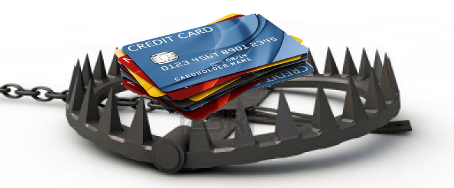 As most people know, credit cards are one of the simplest ways to build credit which then allows us to qualify for a home loan, business loan or even certain jobs. Having a few credit cards for a few years in perfect standing makes us look credit-worthy to banks and lenders. Some jobs use credit history to judge a person’s level of responsibility. So if we need to build credit history, credit cards are necessary. While the ultimate goal of a Money Rebel is to be free of debt, the reality is that most of us will have to utilize debt in order to grow – and for most of us, its credit cards. We need to use them in a way that benefits us while avoiding the common mistakes and traps. But this is a system we can easily use to our advantage.
Credit cards should only have two purposes in our lives:
1) To build our credit
2) Source of emergency funds
We need to change the way we think about credit cards. If something was paid with a credit card, its somehow easier on the conscience. We need to ask ourselves: Would we still make this purchase if we had the cash in our pocket? And if we would, how would we feel about it? We will mostly likely discover that we feel differently about each scenario. The problem is that credit cards are terribly convenient. Whatever you need is at your fingertips with a swipe of a card. We can easily let our guard down and buy additional things we don’t need which we wouldn’t have bought if it was a cash transaction. We also have the mentality that a credit card bill is just another bill, like cell phone or cable. We have all seen how people get in over their heads quickly.
Everyone knows credit cards charge interest, but on a monthly statement it looks like a non-issue. Lets assume a 24% interest rate (normal for a person with little or bad credit history) and a monthly average balance of $1000. The minimum payment would be about $25 since most cards calculate the minimum payment as 2.5% of the balance…. “$25?? Peace of cake, I’ll just send that for now so I can focus on other things”. Now for the part most people don’t bother looking for – the interest payment. In this common scenario, and based on this interest rate, the interest payment is $20, so out of the $25 minimum payment only $5 is going against the actual debt. See how easily we throw away $20? How many things do we NOT buy in order to not waste $20? How many things do we do in order to save $20? If you bought something for $1000 and kept the balance for 6 months, you would have paid about $100 in interest – which means after six months, your $1000 purchase actually costed you $1100. We probably would not have bought it if it was $1100 because we know we can get it for $1000, we’re not dumb. Or are we?
What many people don’t know is that if you pay a balance in full each month, there is no interest charge. And you don’t need to keep a balance in order to build credit. So if we spend with a credit card what we normally would spend with cash AND use that cash to pay off the balance IN FULL, we build our credit without having to pay interest and throwing away money.
Some credit cards lure us in with the promise of rewards, discounts and even cash back. It’s a dirty trick because usually these rewards cards have higher interest rates. There are cards that will give us anywhere between 2% and 6% percent back on our purchases, especially food and gas. So they charge 25% interest and generously give us back 5% on some purchases?! They are betting that you will keep a balance and statistics show that most people do. But the cash back and rewards are a great reason to use the card as long as we pay the full balance every month. Otherwise, they can be giving us back 3% one time on our purchase but will make more than that if you keep the balance for more than one month. Sinister! Here is another one. Ever been to a department store and the deal is “Put your purchase on your credit card and we will give you a 15% discount!”. What they don’t tell us that with the monthly interest they charge (which is higher than regular credit cards), we are slowly giving back that discount. After 6 months, we are giving them more money than if we would have made a full price cash purchase at the register.
Rule of thumb: Respect credit cards like we do cash. Use them to our advantage and put that cash towards paying off the full balance each month and three things happen:
1) We get the cash back, rewards or discounts associated with the card.
2) We avoid losing money to interest while keeping the convenience of plastic.
3) We build out credit.
Win, Win, Win.
RothIRA + $458 a month + Dripping = Retirement

RothIRA – you want one. Allow us to tell you why.
There are tons of stocks and mutual funds and other things to invest in. The type of account we do it from matters. Not only does each transaction carry a possible fee (adding to our costs) but also for the taxes we pay. A regular trading account is taxable. The company that houses the account (Scottrade, eTrade, etc) will report to the IRS the money that you have made in this account. Yup, even here The Man has his hand out. They will also send you a form to include when you file your taxes. In a regular account you will be taxed on any winnings you took for the year.
Few people have heard of a RothIRA and most do not know that it is tax free. This is not a regular account from where we take profits whenever we want. There are rules to follow in order to keep the tax-free status. These rules are not bad at all if the investments we put in there are meant for retirement or for the long term. Basically, whatever your account is worth when you reach retirement age is tax free.
Most people have heard of a 401k – this is a retirement account managed by someone else. When you retire you can withdraw it, pay taxes on it and ride into the sunset with the rest. A RothIRA is similar, except that you manage it yourself and when you reach retirement, your genius investments and all of their profits are all yours – no taxes. This is meant for us regular folks to get a leg up – its an opportunity! Rich people can’t participate and the amount us regular folks can invest is currently limited to $5,500 a year. So if you can save $458 a month, put it in a RothIRA, invest it in dividend-yielding stocks or mutual funds and reinvest those dividends right back (to produce even more dividends, and on and on), you can do very well for yourself.
This is called a “Dripping” which comes from DRIP (Dividend Reinvestment Programs), an investment program that corporations would offer people to buy their stock and conveniently reinvest dividends into more of the same stock without the transaction fees a broker would charge. We can drip by ourselves with whatever dividend-producing stock or mutual fund we choose. Some brokerage accounts allow you to setup a drip automatically free of charge. Think about it, you picked a stock that you will buy more of over time and every once in a while you get more of it for free. Those free stocks will produce more free stock that will produce more free stock! Free! Free! Free!
Dripping in a tax-free RothIRA is a powerful investment strategy. Here is an example: assuming you open a RothIRA account with $5,000 and invest $458 a month in stocks (or mutual funds or whatever you like) that grow 4% annually on average, while yielding a 4% dividend on average along the way for 30 years, you will accumulate over $672,000. Those $458 every month for 30 years is almost $165,000 if all you did was put it in the bank (or stuff it in your mattress). But invested in a RothIRA with a dividend reinvestment strategy can be much more valuable – enough to retire on.
Interestingly enough, there are qualifying life events that can allow you to withdraw before retirement age without paying taxes or penalties. These include, first home purchase and paying your child’s college education. More reasons to open a RothIRA.
Investing in a RothIRA with a dripping strategy is like free money. A Money Rebel likes free money.
… At Least Make Your Journey Less Stressful

Most of us imagine a life of prosperity. Some of us are making moves to get there. As confident as we may be that we will make it we also need to also be honest with ourselves and accept the fact that we will be working for a good long while before we make it. Our happiness during the majority of this time depends on how much we NEED the job to get by. When someone does not NEED a job there is a different energy about them. On a subconscious level that person navigates life as if on another level. On that same subconscious level, people perceive and treat that person differently. By lightening our financial burdens we can become that person and reap the benefits as well as have peace while we are still working-class.
In my professional experience I have met people who were obviously in good shape with money (high proportion of disposable income or spending power). How can those be obvious in a world where most people lived off of credit cards? The ones truly in good shape carried themselves with less worry and saw the job as a mutually beneficial arrangement rather than submission to a corporate slave master.
People that could not survive without a paycheck lived in fear, a fear that could be sensed. They are highly cautious, show stress and are generally overly concerned with pleasing the person sitting one rung higher on the ladder. These same people seem to be the ones that work the most overtime, receive the most pressure from their managers and are always in the hot seat. However, this energy they carry with them seems to attract the heat. I have even experienced offices where heads of households with children seem to have it the worst. The more they NEED the job, the more the job abuses them.
On the other hand, the ones in good shape don’t see their job as their master. They don’t complain as much because their job is optional as far as their immediate short term life is concerned. They get along better with their managers. It’s almost as if this energy about them gets them more respect. It is understood that they they don’t NEED the job. Generally, they are subconsciously accepted as a higher class than their peers by everyone in that environment.
We should be motivated to elevate our financial condition in order to live with less stress and less hatred toward having to be employed. Let’s adjust our finances and reduce our debt. The less we need the next paycheck to cover our expenses the less stress we feel overall and this allows an easier life as we continue to work towards our ultimate goal of complete financial independence.
Controlling Our Finances, Controlling Our Future

Nothing holds us back like bills. We can easily see our money committed to expenses before we even earn it. Many times we do it to ourselves. The system we live in facilitates debt. This was a major reason for the Great Recession but unfortunately many of us have not yet learned that debt can enslave us and if not used with care can keep us enslaved and prevent us from becoming financially independent.
Credit cards and loans can easily become a large part of our monthly expenses and since so much of our money goes to pay these debts we have less money left over (if anything at all) to put towards constructive things for our future and financial well-being. One thing many do not consider is that interest is being added to this debt which automatically makes things more expensive that what we would be willing to pay if we were using cash!
So what can we do? For starters, we need to have pride in ourselves and that pride says we will buy our OWN things and pay our OWN way. Lets keep in mind that when we use loans and credit cards, we are using someone else’s money. If we want to be financially independent, lets start thinking that way. At the same time, we will not be spending on anything we do not truly need. The main goal is to bring our expenses down as low as possible and eliminate unnecessary bills and debt so that we keep as much of our income as possible. We need to be strong enough to sacrifice some comforts and conveniences. Do we want financial independence bad enough to make the necessary moves? If we do, then we have the right mentality. The Money Rebel has come up with some basic ways we can start liberating ourselves financially.
Make a list of all of our bills
Ask what is essential and what is optional. In other words, what are our needs and what are our wants. Some we can do little about – such as housing, food, healthcare, etc. Others we create for ourselves.
What can we eliminate immediately?
There are things we pay for and do not need. From services to subscriptions, most of us can find little things that separates us from our money. Lets be cold and heartless when we turn our backs on them because we do not need them – we need our money.
What can we replace with lower cost versions?
There are things we need but might be able to pay less for. Can we pay cheaper rent down the street? Can we give up the lease and buy an inexpensive car outright? Is there a better insurance rate for our car or home? Cheaper gym membership? Lower cell phone plan? How much TV do we watch – do we really need that cable bill? Are we buying a new shirt because we absolutely need it or are we just bored with our current selection? Question every expense and every purchase! We allow many expenses because they are so small – but they add up. Even if they total up to a hundred dollars in one month it is worth considering. How many hours would I have to work to make up that same amount?
After eliminating everything we can, lets use our left over money to pay off credit cards!
We have a sense of security when we have cash. However, if we have a similar amount in credit card debt, we don’t really have anything! We need to understand that we are in a better financial condition by having little cash and little credit card debt than having more cash and more credit card debt. We are going to have to face this debt at some point. The longer we put it off, the more it is going to cost us. We tend to prefer to keep the cash in our pocket and put off the debt by paying the minimum. We also tend to forget that if we use the cash to pay the credit card, we keep the same buying power (via the credit card) while eliminating the interest-rate. Remember, the card will always be available for emergencies!
When we start paying down our debt, the related bills start to go away and we will feel better about ourselves. There will come a time where the money we were using to pay down our debt now has nowhere to go but our pockets! Now we can start thinking about saving money. We also open ourselves up to opportunities such as investments and a realistic path to owning our own businesses or owning our own homes – Wouldn’t it be great to eliminate THAT bill?!
Where we are in 5, 10, 15 or 20 years depends on what we do right now. Lets create a better financial future. Let’s start by eliminating our excess bills, reducing how much we spend on the ones we need to keep, and paying off our debt. These are the things that hold us back – so why allow it? Lets rebel!
 Money Rebels