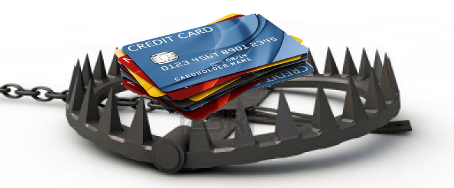
 As most people know, credit cards are one of the simplest ways to build credit which then allows us to qualify for a home loan, business loan or even certain jobs. Having a few credit cards for a few years in perfect standing makes us look credit-worthy to banks and lenders. Some jobs use credit history to judge a person’s level of responsibility. So if we need to build credit history, credit cards are necessary. While the ultimate goal of a Money Rebel is to be free of debt, the reality is that most of us will have to utilize debt in order to grow – and for most of us, its credit cards. We need to use them in a way that benefits us while avoiding the common mistakes and traps. But this is a system we can easily use to our advantage.
Credit cards should only have two purposes in our lives:
1) To build our credit
2) Source of emergency funds
We need to change the way we think about credit cards. If something was paid with a credit card, its somehow easier on the conscience. We need to ask ourselves: Would we still make this purchase if we had the cash in our pocket? And if we would, how would we feel about it? We will mostly likely discover that we feel differently about each scenario. The problem is that credit cards are terribly convenient. Whatever you need is at your fingertips with a swipe of a card. We can easily let our guard down and buy additional things we don’t need which we wouldn’t have bought if it was a cash transaction. We also have the mentality that a credit card bill is just another bill, like cell phone or cable. We have all seen how people get in over their heads quickly.
Everyone knows credit cards charge interest, but on a monthly statement it looks like a non-issue. Lets assume a 24% interest rate (normal for a person with little or bad credit history) and a monthly average balance of $1000. The minimum payment would be about $25 since most cards calculate the minimum payment as 2.5% of the balance…. “$25?? Peace of cake, I’ll just send that for now so I can focus on other things”. Now for the part most people don’t bother looking for – the interest payment. In this common scenario, and based on this interest rate, the interest payment is $20, so out of the $25 minimum payment only $5 is going against the actual debt. See how easily we throw away $20? How many things do we NOT buy in order to not waste $20? How many things do we do in order to save $20? If you bought something for $1000 and kept the balance for 6 months, you would have paid about $100 in interest – which means after six months, your $1000 purchase actually costed you $1100. We probably would not have bought it if it was $1100 because we know we can get it for $1000, we’re not dumb. Or are we?
What many people don’t know is that if you pay a balance in full each month, there is no interest charge. And you don’t need to keep a balance in order to build credit. So if we spend with a credit card what we normally would spend with cash AND use that cash to pay off the balance IN FULL, we build our credit without having to pay interest and throwing away money.
Some credit cards lure us in with the promise of rewards, discounts and even cash back. It’s a dirty trick because usually these rewards cards have higher interest rates. There are cards that will give us anywhere between 2% and 6% percent back on our purchases, especially food and gas. So they charge 25% interest and generously give us back 5% on some purchases?! They are betting that you will keep a balance and statistics show that most people do. But the cash back and rewards are a great reason to use the card as long as we pay the full balance every month. Otherwise, they can be giving us back 3% one time on our purchase but will make more than that if you keep the balance for more than one month. Sinister! Here is another one. Ever been to a department store and the deal is “Put your purchase on your credit card and we will give you a 15% discount!”. What they don’t tell us that with the monthly interest they charge (which is higher than regular credit cards), we are slowly giving back that discount. After 6 months, we are giving them more money than if we would have made a full price cash purchase at the register.
Rule of thumb: Respect credit cards like we do cash. Use them to our advantage and put that cash towards paying off the full balance each month and three things happen:
1) We get the cash back, rewards or discounts associated with the card.
2) We avoid losing money to interest while keeping the convenience of plastic.
3) We build out credit.
Win, Win, Win.
 Money Rebels
This was a very well written article. Credit cards should definitely be treated the same as cash, and paid in full every month.
The only thing is that I would rather not count a credit card as an emergency source. Well, it’s an emergency source after your emergency fund, I guess. However, once you start using credit as an emergency source it’s harder to get out of the cycle.
That’s a valid point and a very conservative approach. However I suggest that anyone wanting to maximize their potential should invest their excess cash and use a credit card for emergency funds as a “place holder” for that cash – I never suggest to keep a balance. I would prefer to not have cash sitting around losing value waiting for an emergency. Instead, I prefer to have it well invested in stocks or mutual funds. In the event of an emergency, it can take several days to liquidate, withdraw and have these funds on hand. In the meantime, I feel that using a credit card is appropriate. The cash, which would have otherwise been sitting around, is on the way and should be used to pay off the card.
Thanks for reading!